The Econ Data Lab
The Economics Data Lab for Business and Research Applications – Econ Data Lab - enriches students’ education by fostering the application of cutting-edge econometric models and solid economic theory to real-world problems through hands-on experience. Currently, the Lab has approximately forty students per semester working in groups on different projects.
This experience has been central to students’ academic and professional development. They consistently engage with complex empirical questions, approach problems with rigor, and translate economic theory into well-structured empirical analysis. Through this research work, students significantly strengthen their statistical and data analysis skills, developing a sophisticated understanding of how quantitative methods can be applied to real-world issues.
The Lab develops not only technical competence but also intellectual maturity and genuine curiosity, reinforcing the students’ commitment to quantitative methods and data science.
Working in groups of four, students become familiar with a specific dataset, which can be provided by the lab or constructed by the students themselves. They clean, process, explore and analyze the data. The main research question may be proposed by me, or the group may identify an interesting question independently. Students research the literature and decide which economic and econometric models will be used. At the end of the semester, groups present their results and conclusions to all other groups, allowing for knowledge spillovers and learning from peers’ projects.
At no point are students told exactly what to do, as in a research assistantship; instead, they are guided to make autonomous decisions about both what to do and how to do it. The main purpose of the Lab is to encourage students to think independently and to become familiar with all stages of a research project, including its challenges.
Many students return for a second semester and work on a different project with a new dataset and group. The ability to adapt and collaborate is considered as important as analytical and coding skills.
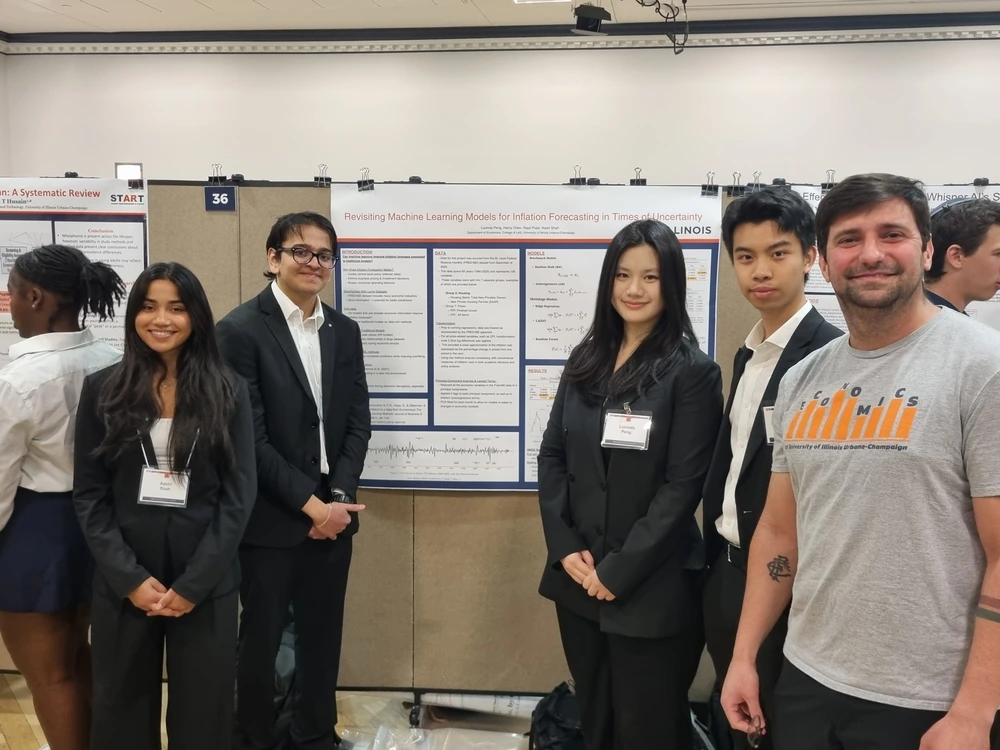
Some students have presented at the Undergraduate Research Symposium (seven last year and approximately ten this year), and some have pursued graduate studies (twenty-nine letters of recommendation have been written since the Lab was established), demonstrating their commitment to a research-oriented environment.
About Dr. Daniela Alonso Fontes:
I have been a Clinical Assistant Professor at UIUC since January 2023, working to establish the Econ Data Lab. Prior to this position in Champaign, I managed a similar lab at the Pontifical Catholic University of Rio de Janeiro in Brazil. I have been teaching undergraduate economics courses for more than ten years. In Fall 2023, I began teaching Data Analysis for Problem Solving, and in Spring 2024, the Econ Data Lab was launched with approximately thirty students working across ten projects. The Lab was designed as a first step toward immersion in a research environment.
While it is preferable that students entering the Lab have completed some econometrics coursework and have prior coding experience, the Lab also accepts first-year students with no prior background. No previous research experience is required. For this reason, the focus is placed on the research process rather than the final results. Grades are based on effort, willingness to learn, commitment, and participation. Asking questions and expressing doubts is valued as much as providing answers, and students are encouraged to take intellectual risks and move beyond their comfort zones.
In 2025.2 alone, we had a total of 17 LAS non-Economics students. Over the past two and a half years, students have come from statistics, astronomy, political science, chemical and biomolecular engineering, mathematics, communication, philosophy, and global studies.
The complexity of projects is tailored to students’ backgrounds, and the primary focus remains on the process of developing a research project.