The effects of plastic contamination on reproductive health
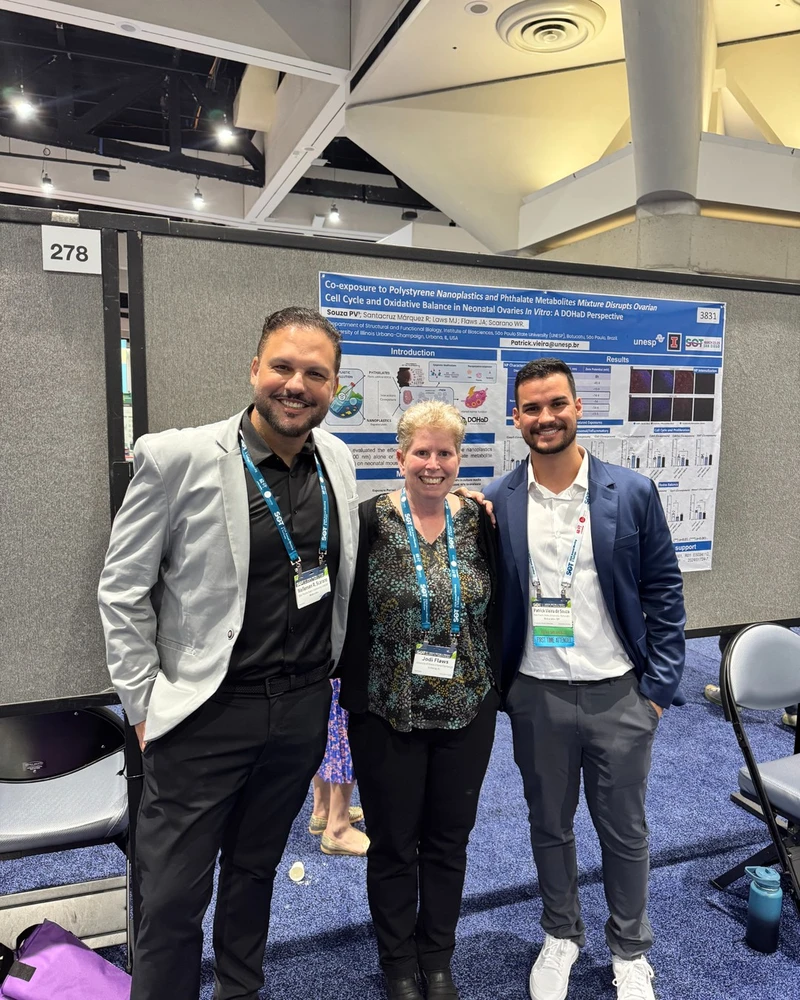
Dr. Jodi Flaws (University of Illinois Urbana-Champaign) and Dr. Wellerson Scarano (São Paulo State University in Brazil) developed a research collaboration that is designed to examine the effects of perinatal exposure to plastic contamination (micro/nanoparticles and phthalates) on reproductive health in female and male offspring. Dr. Flaws, Dr. Scarano, and their research teams are working together to test the hypothesis that perinatal exposure to environmentally relevant concentrations of plastic contaminants (micro/nanoparticles and phthalates) adversely impacts the development and function of the reproductive system in male and female offspring. Drs. Scarano, Dr. Flaws, and/or their graduate students are spending time in each other’s laboratories designing experiments, conducting experiments, discussing results, analyzing results, and writing scientific manuscripts.
To date, Dr. Flaws’ and Dr. Scarano’s laboratories have found that maternal exposure to phthalates and/or micro/nanoplastics adversely affects both the male and female reproductive organs. Specifically, they determined that perinatal exposure to phthalates and/or micro/nanoplastics interferes with the ability of the adrenal glands to make steroid hormones and alters the proteomic and inflammatory profiles in the prostate in a manner that increases prostate cancer risk in rodents. They also found that phthalate and micro/nanoplastic exposure disrupts ovarian health in mice. Collectively, these data indicate that phthalates and micro/nanoplastics are developmental and reproductive toxicants in both males and females. As a result of these studies, Dr. Flaws, Dr. Scarano, and their research team have published several scientific manuscripts and presented their findings at several scientific conferences (see below).
Drs. Flaws and Scarano are excited that their collaborative research project fits into two research themes in the Brasillinois Program. The project fits into the Public Health and Medicine Theme because it focuses on the effects of environmental plastic contaminants on female and male reproductive health. The project also fits into the Climate and Sustainability Theme because climate change is leading to the degradation of plastics in the environment. This plastic degradation leads to an increase in the amount of known toxicants such as micro/nanoplastics and phthalates that leach from plastics. In turn, this increases human exposure to toxicants and increases risk of adverse health outcomes, including adverse reproductive outcomes.
As a result of the collaborative project, Drs. Flaws, Dr. Scarano, and their trainees published 5 scientific manuscripts in premier journals in their field. Below is a list of the published manuscripts to date.
Magosso, N., Vieira de Souza, P., Aquino, A.M., Rocha, V.A., Fioretto, M.N., Costa, L.G.A., de Campos, S.G.P., Barbisan, L.F., Justulin, L.A., Flaws, J.A., Scarano, W.R. (2025) Maternal exposure to an environmental relevant phthalate mixture modulates the steroidogenic genes in the adrenal glands throughout postnatal development of male rats. Environmental Toxicology 40:1294-1307.
Souza, P.V., Aquino, A.M., Alonso-Costa, L.G., Magosso, N., Oliveira, M.A.F., Rocha, V.A., Fioretto, M.N., Moreira, M.F., Pinha, V.C., Caxali, G.H., Justulin, L.A., Flaws, J.A., Scarano, W. (2025) Maternal phthalate exposure alters the prostate proteome in offspring rats: linking omics insights to prostate cancer risk in humans. Archives of Medical Research: Special Issue on DOHaD and Environmental Contaminants Sep 6;57(2):103297. doi: 10.1016/j.arcmed.2025.103297.
Santacruz Márquez, R., Vieira de Souza, P, Scarano, W.R., Flaws, J.A. (2026) Impact of nanoparticles and nanoplastics on female reproductive health. Biology of Reproduction Feb 10:ioag036. doi: 10.1093/biolre/ioag036. Online ahead of print.
Souza, P.V, Santacruz Márquez, R., Laws,M.J., Flaws, J.A., Scarano, W.R. (2026) Isolated and combined exposure to polystyrene nanoplastics and a phthalate metabolite mixture disrupt antral follicle growth and function of mice in vitro. Toxicological Sciences Apr 7;209(4):kfag036. doi: 10.1093/toxsci/kfag036.
Rocha V.A., Cavalheiro M., Souza P.V., Magosso N., Fioretto M.N., Moreira M.F., Pinha V,C., Aquino A.M., Quadreli D.H., Fernandes G.S.A., Justulin L.A., Flaws J.A., Scarano W.R. (2026) Gestational and lactational exposure to phthalates and nanoplastics induces inflammation and oxidative imbalance in the prostate of adult rats. Toxicological Sciences (in press).
The funding was essential for establishing and expanding the collaboration between scientists and institutions in Illinois and Brazil. Without the financial support, the investigators would not have been able to conduct the research studies. The funding provided the incentive to work together on a new project and provided the actual money to purchase the required laboratory supplies and reagents. The funding was also essential for allowing a trainee from Brazil to spend time at the University of Illinois in Dr. Flaws’ laboratory conducting the research with the help of Dr. Flaws’ trainees. Without the funding, it would not have been possible to host students at the University of Illinois and without the hard work and dedication of the trainees, the research would not have been conducted. In addition, the trainees in the Flaws lab gained new peers and colleagues by working hand-in-hand with the trainees from Brazil. The trainees from Brazil and Illinois have developed life-long friendships and collaborations as have Drs. Flaws and Scarano. Finally, the funding was essential for establishing a network of reproductive toxicologists from Illinois and Brazil. The investigators used some funds to attend scientific conferences in which they could present the work from the collaborative studies. By attending the conferences and presenting the work, the investigators established many new connections with others from Brazil and Illinois. The investigators are extremely grateful for the financial support. It truly has been “life-changing” and opened up many new research collaborations.
For more information about Dr. Flaws’ and Scarano’s laboratories, please click on the links below.