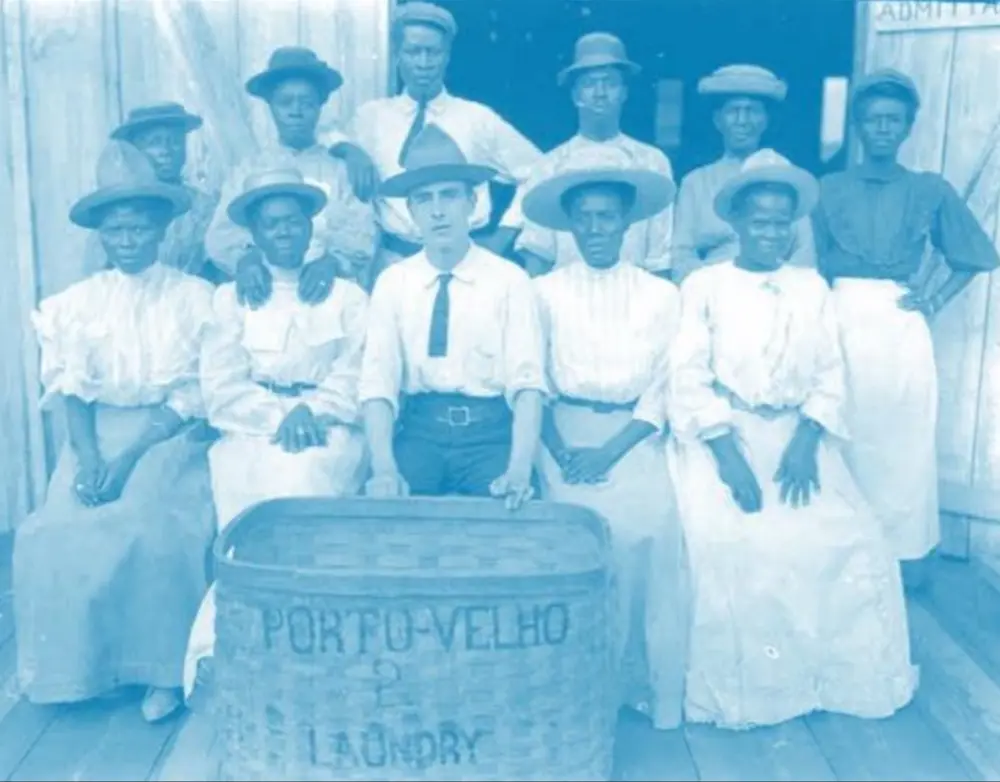
What can a railroad reveal about the making of modern Brazil? Caribbean Amazônia examines the Madeira-Mamoré Railway, a U.S.-funded project built on Indigenous Amazonian land by racialized workers from Brazil and the Caribbean between 1870 and 1943. Drawing on the work of Lélia Gonzalez and Abdias do Nascimento, the research connects Indigenous and African-descendant histories to examine how the railway shaped racial hierarchy, gender norms, Brazilian state-making, and U.S. empire-building. This research is being conducted by Owen MacDonald, a PhD candidate in History and a former Lemann Center Graduate Fellow.+
Owen MacDonald’s dissertation, “Caribbean Amazônia: The Madeira-Mamoré Railway, Labor, and the Making of Race, Gender, and Empire in Northwestern Brazil, 1870-1942,” examines how Black workers from Brazil and the Caribbean joined Indigenous people in the western reaches of the Amazon to create and contest Brazilian state making and US empire building in the late nineteenth and early twentieth centuries.
Over six chapters, MacDonald explores the various attempts to build the Madeira-Mamoré railroad in what is now the Amazonian state of Rondônia. The first two chapters engage the brief attempts made in the waning days of the Brazilian Empire where Indigenous resistance, interethnic worker militancy, and harsh environmental conditions prevented the railroad from successfully being built. The next three chapters explore the process of railroad construction at the start of the twentieth century that laid tracks from what is now Rondônia’s capital city of Porto Velho to Guajará-Mirim, on the border between Brazil and Bolivia. This attempt succeeded because of the appropriation of Indigenous knowledges to thrive in the rainforest and the technical know-how of Afro-Caribbean workers who migrated to the Amazon after gaining experience on other Circum-Caribbean infrastructure projects. More than simply a story of railroad construction, MacDonald reveals how the labor of Black and Indigenous people contributed to and contested the integration of the Amazon region into the Brazilian nation. Funded and overseen by US businesses, the study also reveals the contested nature of US empire building in Latin America at the turn of the twentieth century. The final chapter explores the social world built by Afro-Caribbean women and men in Porto Velho and their ongoing struggles against the erasure of their contributions to building the city, and indeed, modern Brazil.
Supported by the Lemann Center, CLACS, and a Fulbright-Hays fellowship, MacDonald did archival and oral history research in Porto Velho, Rondônia, and Rio de Janeiro, as well as archival research of North American company records at Harvard University and Yale University. Shaped by Afro-Indigenous Brazilian social theory and diasporic Black feminist methods, MacDonald presents the first serious, English-language study of the railroad.
Beyond research, MacDonald is committed to building reciprocal relationships with invested communities in Brazil and the United States. He maintains connections with his host institution, the Federal University of Rondônia, and looks forward to doing more oral histories with Caribbean descendant communities and Indigenous communities affected by the railroad construction as he turns his dissertation into a book.
MacDonald has also taught several classes at UIUC, including History of Brazil. Learning alongside an audience of advanced undergraduate history students and master’s degree students in Latin American and Caribbean Studies, MacDonald organized the class around questions like: How does Brazilian history look if we center the North and Northeast regions instead of the traditional political and economic hubs like Rio de Janeiro and São Paulo? What role do Black and Indigenous people play in creating Brazilian history and culture? How are histories of Brazil, and Latin America more generally, connected with the history of the United States?